Plant Index: Seminum / Rarium
Search/Filter Results:
Category: Seminum | Sub-Category: Perennials for Sun
Scientific Name (Genus/Species): Crambe maritima
Family: (Brassicaceae)
(P) to 2′. Sea Kale. Coastal North Europe, Baltic and Black Seas. Often grown as a vegetable, however, we like it in the mixed border. The early emerging foliage is flushed deep purple; this is the edible stage. The unfurled leaves are wide, wavy, lobed, and glaucous providing an attractive foil for the large panicles of honey-scented, white, four-petalled flowers. Long summer bloomer. Well-drained soil. Sun. 3 & T2


Category: Seminum | Sub-Category: Annuals for Sun
Scientific Name (Genus/Species): Crepis rubra
Family: (Asteraceae)
(A) to 18″. Cretian Hawk’s Beard. We love this annual. Rosettes of toothed, pale green leaves with delicate flower stalks. Dandelion-esque heads one inch across are pale pink with darker centres. Adorable. Sun. 3 & T2

Category: Rarium | Sub-Category: Alpine and Rock Garden
Scientific Name (Genus/Species): Crithmum maritimum
Family: (Apiaceae)
(P) to 12″. Rock Samphire. Southern Europe. A British native known for precariously hanging from rock crevices on the white cliffs of Dover, this fascinating plant has happily established itself in the gravel at the feet of our alpine troughs. A tangle of succulent, flattened, blue-green leaves and stems support sizeable umbels of yellow-green flowerheads. Rock Samphire has a long history as a foraged edible plant and has recently gained in popularity among epicureans for its aromatic and flavourful leaves. Well-drained soil. Sun. 3 & T1

Category: Seminum | Sub-Category: Annuals for Sun
Scientific Name (Genus/Species): Cuphea viscosissima
Family: (Lythraceae)
(A) to 20″. Blue Waxweed. A North American native and one of our most revered annuals. This non-stop summer bloomer has six deep, magenta-purple petals with the upper two being the longest and a tubular green calyx covered in fine purple hairs. An easy-care annual that requires no deadheading or staking. Very sticky stems trap unsuspecting insects. Self-sows. Sun. 4 & T3

Category: Seminum | Sub-Category: Annuals for Sun
Scientific Name (Genus/Species): Cynoglossum amabile ‘Mystery Rose’
Family: (Boraginaceae)
(A) to 2.5′. Chinese Forget-me-not. We love this plant. This wonderful selection is smothered in dusty pink blossoms. A joy in the border. Sun. 3, D & T2

Category: Seminum | Sub-Category: Annuals for Sun
Scientific Name (Genus/Species): Cynoglossum dioscoridis
Family: (Boraginaceae)
(B) to 2.5′. Grey foliage remains basal the first year. Discrete, rosy blooms tinged with blue culminate at stem tips. Definitely a plant for the front of the border. Sun. 3 & T2, cover and keep dark.

Category: Seminum | Sub-Category: Annuals for Sun
Scientific Name (Genus/Species): Cynoglossum officinale
Family: (Boraginaceae)
(B) to 3′. Hound’s Tongue. Europe. Greyish green, silky foliage remains basal the first year. Branched, one-sided cymes are covered with delicate, bell-shaped blooms of a dark, muted, reddish purple. Traditionally used to treat leg ulcers, bites, and minor injuries. This herb can be now found naturalized around older settlements. Sun. Well-drained soil. 3, D & T2

Category: Rarium | Sub-Category: Perennials for Sun
Scientific Name (Genus/Species): Datisca cannabina
Family: (Datiscaceae)
(P) to 7′. False Hemp. An imposing herbaceous plant from India with graceful arching stems and finely divided foliage. A midsummer bloomer with ornamental tassel-like yellow flowers in racemes. This herb yields a yellow dye often used for silks. We have enjoyed it in a pot and now love it in the garden. Sun. 3 & T2


Category: Seminum | Sub-Category: Ornamental Grasses
Scientific Name (Genus/Species): Deschampsia cespitosa
Family: (Poaceae)
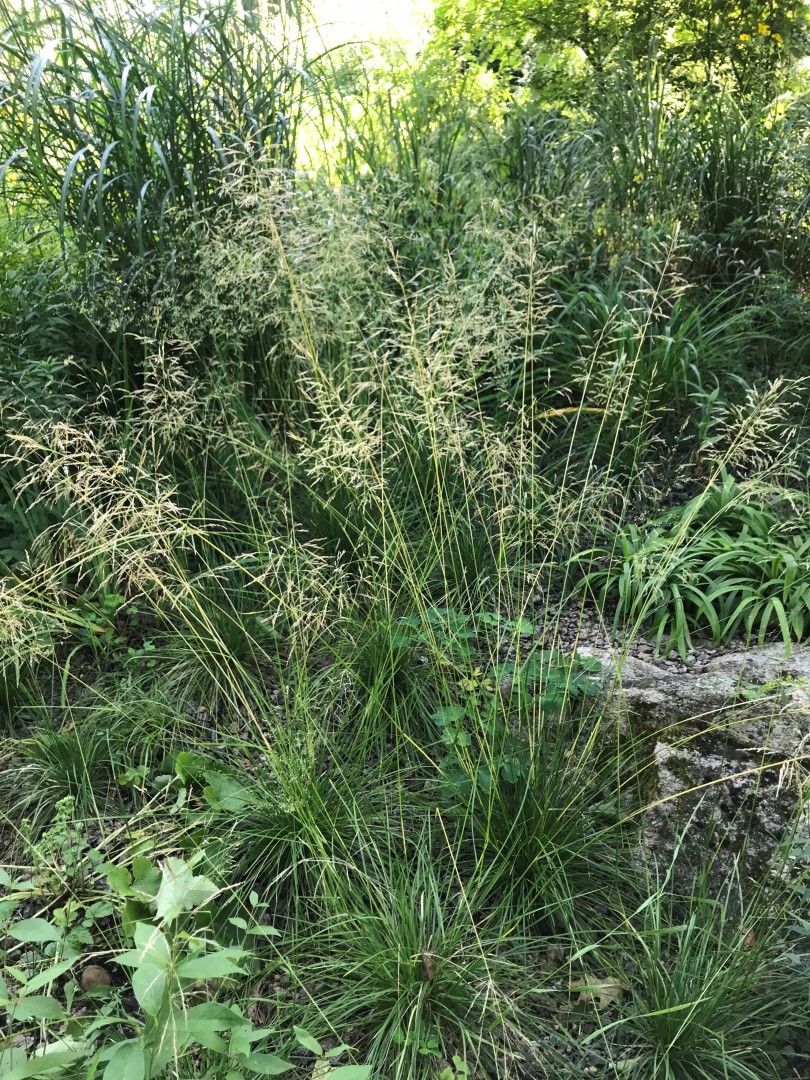
(P) to 3′. Tufted Hair Grass. North America. This semi-evergreen grass forms a dense clump of narrow, dark green leaves up to 18 inches long. In early summer, finely textured, arching flower stalks rise to 3 feet. Spikelets (flower clusters) are single at the tips of slender branchlets with hair-like awns and are greenish-silver to purple-tinged. As the season progresses the spikelets bleach to tawny and remain attractive, persisting well into winter. Bonus: Larval food plant for several butterflies in North America including the Umber Skipper. Sun/partial shade. 4 & T1
Category: Rarium | Sub-Category: Shrubs and Vines
Scientific Name (Genus/Species): Deutzia crenata var. nakaiana
Family: (Hydrangeaceae)
Perennial shrub to 2′, spreading to 4′. Japan, Southeast China. Dwarf Deutzia. A pretty compact, shrub with rich green leaves, turning purple-red in autumn. Panicles of star-shaped white flowers. Perfect for the rock garden or front of the border. Blooms June to July. Full sun. Very hardy. 4 & 6 & T3

Category: Seminum | Sub-Category: Wildflowers
Scientific Name (Genus/Species): Dianthus armeria
Family: (Caryophyllaceae)
(A/B) to 2′. Deptford Pink. Europe. This charmer has a very slender and delicate appearance. The narrow leaves are widely spaced and paired along the stem. At the ends of the stems are short-stalked or stalkless clusters of deep-pink flowers that are surrounded by erect, hairy, leaf-like bracts. The flowers are comprised of five lanceolate petals, each with irregular serrated edges and small white spotting on the upper surface. Self sows. Sun. 4 & T2

Category: Rarium | Sub-Category: Annuals for Sun
Scientific Name (Genus/Species): Dianthus barbatus – Darkest of All
Family: (Caryophyllaceae)
(B/A) to 18″. Sweet William. South Europe. Long-lasting, dark maroon to almost black, clove-scented flowers bloom in flat-topped cymes. Attractive dark foliage too. Sun. 4 & T2

Category: Seminum | Sub-Category: Perennials for Sun
Scientific Name (Genus/Species): Dianthus carthusianorum
Family: (Caryophyllaceae)
(P) to 2′. Cluster-head Pink. Native to sunny hillsides and dry meadows throughout central and southern Europe. Dianthus carthusianorum was named to commemorate the monks of the Carthusian order, founded in the 11th century in the Chartreuse Valley in the French Alps. Dense, terminal clusters of five-petalled, toothed, pinkish purple flowers on slender, airy stems. Grassy clumps of narrow, pale grey-green foliage adds to the charm. Blooms in midsummer. Well-drained soil. Sun. 4 & T2

Category: Seminum | Sub-Category: Annuals for Sun
Scientific Name (Genus/Species): Dianthus japonicus
Family: (Caryophyllaceae)
(B/P) to 2′. Hama-nadeshiko, Japanese Dianthus. Japan and East Asia. From lush rosettes of thick, glossy, narrowly ovate basal leaves emerge leafy stalks topped with dense clusters of vivid rosy-purple, five-petalled, toothed blooms. Extremely floriferous the second year from seed and may be somewhat biennial. Persistent winter foliage develops attractive, rich burgundy overtones. Not your typical “Pink.” Blooms midsummer till fall. Well-drained soil. Sun. 4 & T2

Category: Rarium | Sub-Category: Annuals for Sun
Scientific Name (Genus/Species): Dianthus knappii
Family: (Caryophyllaceae)
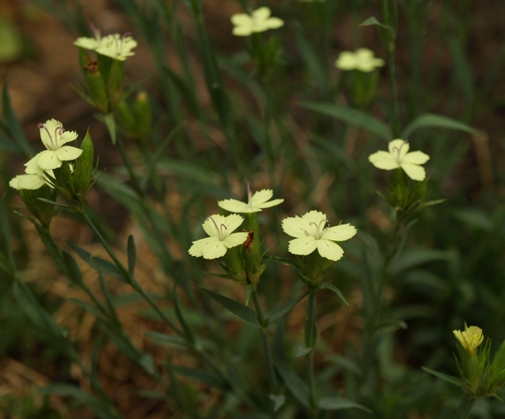
(B/P) to 16″. A unique, yellow flowered Dianthus native to scrubby hillsides and dry, grassy meadows in the Western Balkans. Dense, terminal clusters of soft lemon yellow flowers on slender, nodding stems. Loose, grassy clumps of narrow, pale green foliage. A short-lived perennial that often dies after blooming, best treated as biennial. Blooms in midsummer. Well-drained soil. Sun/partial shade. 4 & T2

 Browse the index >>