Plant Index: Seminum / Rarium
Search/Filter Results:
Category: Rarium | Sub-Category: Alpine and Rock Garden
Scientific Name (Genus/Species): Pulsatilla patens
Family: (Ranunculaceae)
(P) to 12″. Eastern Pasque Flower. Native to Europe, Russian, China, Canada and US. Blooming in April at 4″ high, before the leaves develop, the ethereal, open, bell-shaped, flowers command attention. The solitary, two-inch flower has six blue-violet, petal-like sepals and a ring of many yellow staminodes that surround a light green central boss of stamens. The sepals are pointed at the tip and lined with many parallel veins. Flowers, stems and foliage are all covered in fine, silky, whitish hairs. The flowers are followed by plume-like seed heads (reminiscent of some Clematis and Geum) that have good ornamental interest. Deeply divided basal foliage grows to 12 inches tall after the flowers have faded. A great rock garden plant and the state flower of South Dakota. Grows best in drier, sandier soil. Sun. 3 & T2 & ∆

Category: Seminum | Sub-Category: Pots/Garden (overwinter indoors)
Scientific Name (Genus/Species): Puya chilensis
Family: (Bromeliaceae)
(TP) to 13′. An easy, “must-have” native to the arid hillsides of Central Chile. Dense, basal rosettes of pale green leaves reach up to three feet in length, and are amply equipped with hooked, leathery, marginal spines. In the wild, the flowers appear on stalks up to 10 feet tall atop which sits a three-foot long flowerhead. These prominent flowers have strident, green-yellow sepals, chartreuse petals, and bright yellow anthers. Our greenhouse specimen reaches a respectable five feet. Sun. 4 & T2, keep moist
Category: Rarium | Sub-Category: Pots/Garden (overwinter indoors)
Scientific Name (Genus/Species): Puya mirabilis
Family: (Bromeliaceae)
(TP) to 5′. Argentina and Bolivia. Silvery-brown, finely toothed leaves. Delicate, three petalled, chartreuse-green flowers with golden anthers appear intermittently on stalks up to five feet tall. A very distinct looking Puya. Choice. Sun. 4 & T2, keep moist

Category: Seminum | Sub-Category: Wildflowers
Scientific Name (Genus/Species): Pycnanthemum muticum
Family: (Lamiaceae)
(P) to 4′. Mountain Mint. North America. Flat-topped clusters of white to pale violet flowerheads are surrounded by large, silvery bracts that give the plants a delightful, frosted appearance. Pointed, oval, very aromatic, deep green leaves with a clean, pungent, minty fragrance. Midsummer. Moist, well-drained soil. Sun/partial shade. 4 & T2

Category: Rarium | Sub-Category: Perennials for Sun
Scientific Name (Genus/Species): Pycnanthemum pilosum
Family: (Lamiaceae)
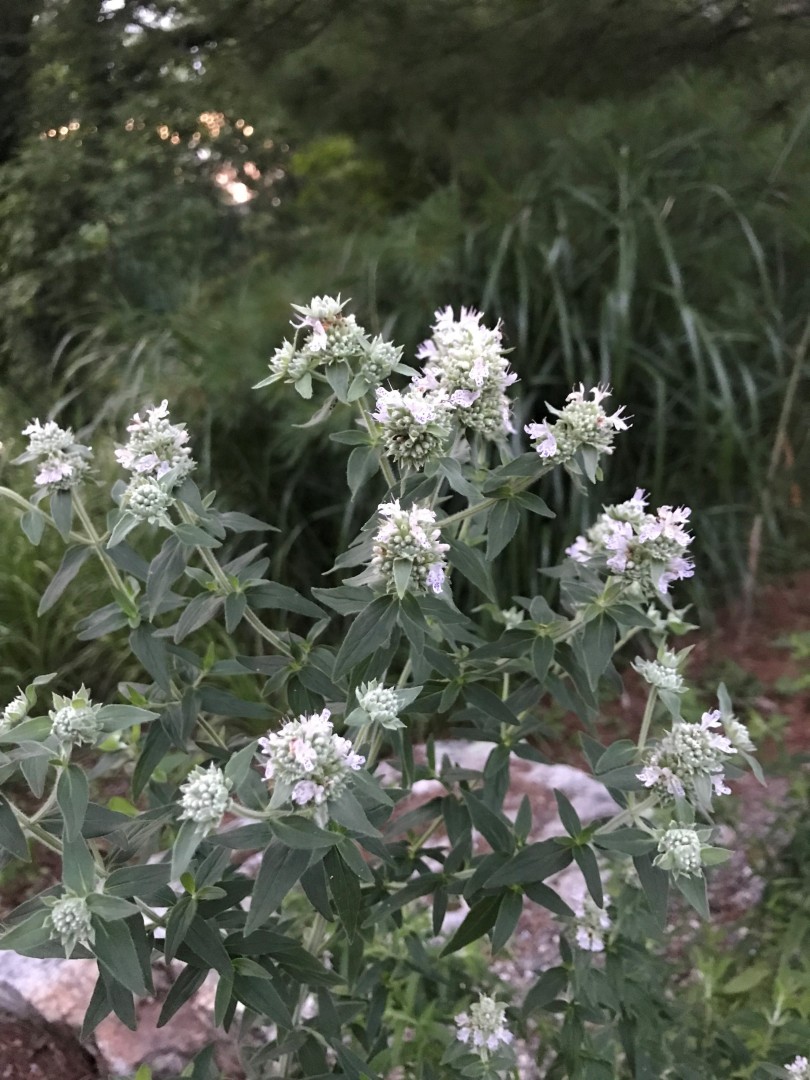
(P) to 3′. Hairy Mountain Mint. Eastern and Central US. This herbaceous perennial branches frequently to create a slender bushy appearance with flowers appearing in both terminal and axillary clusters. The stems are light green, 4-angled, densely pubescent on all sides (giving an overall grey appearance), and very aromatic when bruised. The upper stems terminate in branching flowerheads that are flat-topped, spanning up to one inch across. The typical mint-like flowers are hooded and lipped with purple specks and dots scattered across its throat and the lobes of its lips. The nectar-rich flowers are very attractive to many native pollinators. A good candidate for the white garden. Sun. 4 & T2
Category: Seminum | Sub-Category: Wildflowers
Scientific Name (Genus/Species): Pycnanthemum tenuifolium
Family: (Lamiaceae)
(P) to 3′. Slender Mountain Mint. North America. A very aromatic plant with a peppermint scent and taste. Narrow, linear leaves. Flat-topped clusters of white to pink flowers. Long lasting and great in arrangements. A tough and easy plant to grow. Sun. 4 & T2

Category: Seminum | Sub-Category: Alpine and Rock Garden
Scientific Name (Genus/Species): Ramonda myconi
Family: (Gesneriaceae)
(P) to 4″. A shade-lover from the Pyrenees. Deep green, broad, very crinkled, flat rosette. Pale violet, five-petalled flowers with yellow stamens hang from four-inch, slender stems. Likes to grow on north-facing vertical cliffs or in a cool crevice. 4 & T1

Category: Rarium | Sub-Category: Perennials for Sun
Scientific Name (Genus/Species): Ratibida pinnata
Family: (Asteraceae)
(P) to 4′. Grey-headed Coneflower. Central North America. Tall, branched flowers stems are topped by yellow-rayed blooms resembling badminton shuttlecocks. The short, rounded, central cone of each long-lasting flower begins a greyish green and ripens to chocolate brown. The handsome pinnate leaves adorn only the lower half of the flower stems and form a tidy, bushy clump. A much underused, long-blooming and carefree plant. Sun. Well drained soil. 4 & T2


Category: Seminum | Sub-Category: Annuals for Sun
Scientific Name (Genus/Species): Reseda luteola
Family: (Resedaceae)
(A/B) to 5’. Dyer’s Rocket. Long, meandering, slender spikes of small, yellowish flowers top narrow, lance-shaped leaves. A dyer’s plant yielding flavone, used to colour textiles yellow. Long blooming and self-sows. We just love it. Sun. 4 & T2. Best in situ.

Category: Seminum | Sub-Category: Shrubs and Vines
Scientific Name (Genus/Species): Rhus typhina ‘Laciniata’
Family: Anacardiaceae
(P) to 15′. Cutleaf Staghorn Sumac. Eastern North America. A wonderful cultivar of our native Sumac with large, deeply dissected, compound pinnate, bright green leaves giving a fern-like appearance. Female flowers produce showy, pyramidal, fruiting clusters (to eight inches long), with each cluster containing numerous hairy, berry-like drupes which ripen bright red in autumn, gradually turning dark red as they persist through much of the winter. Fruit is attractive to wildlife and can be used to make lemonade. Fantastic autumn colour in shades of orange, yellow and red, as well as interesting architectural winter framework gives this shrub year-round interest. 1 & 2B & 3 & 6

Category: Seminum | Sub-Category: Annuals for Sun
Scientific Name (Genus/Species): Ridolfia segetum
Family: (Apiaceae)
(A) to 4′. False Fennel. Mediterranean. Similar to dill and fennel with lacy, finely divided, grey-green, aromatic foliage. Ridolfia sports many large compound umbels comprised of tiny, bright yellow-chartreuse flowers that give a frothy, airy appearance in our Pink/Chartreuse Bed. Long blooming and great in flower arrangements. Attractive to pollinators. 3 & T1

Category: Seminum | Sub-Category: Woodland
Scientific Name (Genus/Species): Rodgersia podophylla
Family: (Saxifragaceae)
(P) to 4.5′. Rodger’s Flower. This woodland wonder is named in honour of Admiral John Rodgers of the US Navy (1812-1882), distinguished naval officer who commanded in 1852-1856 a Pacific expedition during which the first species of this genus was discovered. This Japanese native has elegant, palmate leaves that emerge bronze when young, turn to green, and take on coppery tones at they mature. Small, white to greenish-white funnel-shaped, apetalous flowers bloom in dense, branched clusters (to 12 inches long) from June to August on upright stems rising 1 to 2 feet above the foliage. Great in shade or try in a cool, sunny place by the water’s edge. A mainstay in our Woodland Garden. 5 & T2

Category: Seminum | Sub-Category: Shrubs and Vines
Scientific Name (Genus/Species): Rosa nutkana
Family: (Rosaceae)
Hardy shrub to 6′. Nootka Rose. Alaska to northern California. The single flowers are a clear lilac-pink with a prominent boss of yellow stamens. Dark, greyish green foliage and strong, relatively thornless, nut-brown stems. Foliage turns a fantastic yellow-orange-red colour in fall, followed by a heavy crop of globular, dark red hips. Sun. 3 & T2 & Δ

Category: Rarium | Sub-Category: Pots/Garden (overwinter indoors)
Scientific Name (Genus/Species): Rostrinucula sinensis
Family: (Lamiaceae)
Tender Shrub to 7′. China. Collected by the Sino British Expedition to Guizho Province. This curious Buddleja relative has grown well for us in pots. Lovely, soft-green, pointed foliage and large terminal, arching spikes formed of chalky-white, tomentose bracts and buds. The flower spike opens gradually to reveal fragrant, purple-lavender flowers with many extruding white stamens. Summer. Well-drained soil. Sun. 4 & 7 for 4 weeks, then T3

Category: Seminum | Sub-Category: Perennials for Sun
Scientific Name (Genus/Species): Rubia tinctorum
Family: (Rubiaceae)
(P) to 2′. Dyer’s Madder. East Mediterranean to Central Asia. The roots of this plant have been used since ancient times as a red dye for leather, wool, cotton and silk. Early evidence of dyeing comes from India where a piece of cotton dyed with madder has been recovered from the archaeological site at Mohenjo-daro (3rd millennium BCE). The red coats of the British Redcoats were dyed with madder, after earlier being dyed with cochineal. The foliage resembles sweet woodruff or bedstraw with whorled lanceolate leaves that are leathery, rough and prickly. The mostly five-petalled flowers are tiny in loose, many branched, leafy cymes, yellow-green to honey coloured. Round, shiny black, berry-like fruit follow. Summer flowering. Sun. 3 & T1

 Browse the index >>