Plant Index: Seminum / Rarium
Search/Filter Results:
Category: Seminum | Sub-Category: Wildflowers
Scientific Name (Genus/Species): Solidago bicolor
Family: (Asteraceae)
(P) to 3′. Silverrod. Eastern North America. An atypical Goldenrod that produces tiny, daisy-like flowers arranged in elongated, cylindrical clusters and have a striking appearance with white petals surrounding yellow disc florets. So different than the more usual golden yellow clusters of the Goldenrod. Blooming in late summer to early fall, the flower heads rise above basal rosettes of toothed, grey-green foliage. This well-behaved native adapts well to most soil and light conditions. Pollinators of all sorts are attracted to it and birds enjoy the seed. Part to full sun. 4 & T2


Category: Seminum | Sub-Category: Wildflowers
Scientific Name (Genus/Species): Solidago caesia
Family: (Asteraceae)
(P) to 3′. Blue-stemmed Goldenrod. Eastern North America. A plant of the woodland edge and clearings. Graceful, arching, bluish tinged stems with small, golden yellow flowers clustered in the leaf axils. The narrow, dark green, lance-shaped leaves are sharply toothed and slightly hairy. Blooms August through September. Well-drained soil. Partial shade. 4 & T2

Category: Seminum | Sub-Category: Wildflowers
Scientific Name (Genus/Species): Solidago canadensis
Family: (Asteraceae)
(P) to 5′. Canadian Goldenrod. This North American native with its rhizomatous growth is perfect for the meadow. Central stems are clad with many narrow, alternate, lance-shaped, sharply-toothed, leaves with conspicuous lateral veins. The leaves are hairless above but hairy beneath and tapered at each end. Stems are topped in late summer to fall with large horizontally branched, terminal pyramidal panicles containing one-sided recurving branches filled with masses of tiny yellow flowers, each to 1/8″. A magnet for pollinators, beneficial insects, and birds. Average soil. Full sun. 4 &T2

Category: Seminum | Sub-Category: Wildflowers
Scientific Name (Genus/Species): Solidago ptarmicoides
Family: Asteraceae
(P) to 2′. Upland White Goldenrod. North America. This unique Goldenrod is such a charmer, with delicate white Aster-like blooms and narrow linear grasslike, dark green foliage. Sporting blooms that persist in late summer to fall, this is a great pick for a meadow or full-sun garden. Goldfinches love to eat the seed! 4 & T2


Category: Seminum | Sub-Category: Wildflowers
Scientific Name (Genus/Species): Solidago puberula
Family: Asteraceae
(P) to 3′. Downy Goldenrod. North America. A less cultivated member of the genus, with unique, bright yellow flowers bearing eye-catching, large disk florets surrounded by strap-like ray florets, borne on leafy stems covered with fine, spreading hairs. This species has ovate, dark green glabrous foliage varying greatly in size depending on growing conditions. Fantastic in a native or prairie garden, best in full sun to part shade. 3 & T1

Category: Seminum | Sub-Category: Wildflowers
Scientific Name (Genus/Species): Solidago rugosa
Family: (Asteraceae)
P to 5′. Wrinkleleaf Goldenrod. Central and eastern North America. This clump-forming plant has numerous, narrow, deeply toothed, dark green leaves with a wrinkled appearance to the upper surface. Tall, rough, hairy stems bear arching branches with panicles of small, light yellow flowerheads concentrated on the upper side. Physicians in ancient times believed that goldenrod had healing powers; in recent times these plants have been commonly blamed for causing hay fever, but its irritating symptoms are actually caused by ragweed (Ambrosia species), whose pollen is abundant when goldenrod is in flower. All parts of this plant are useful in the native ecosystem, from the nectar and pollen of the flowers, to the foliage and seeds, even to the roots that act as a soil stabilizer. Blooms July to October. A “must have” for the wildflower garden. Sun. 4 & T2

Category: Seminum | Sub-Category: Ornamental Grasses
Scientific Name (Genus/Species): Sorghastrum nutans
Family: (Poaceae)
(P) to 5′. Indian Grass. Eastern North America. Perhaps one of the most beautiful of all prairie grasses. Sturdy, upright clumps of narrow, green foliage become bright burnished orange in the fall. Erect stems with showy flower panicles are copper coloured with conspicuous yellow pollen sacs. The paired spikelets have distinctive, bristly awns giving them a soft, delicate, feathery quality. Adaptable to a wide variety of uses. Indian Grass will grow in most soils and will even tolerate some shade, though it prefers a rich, loamy soil with plenty of sun. 4 & T1

Category: Seminum | Sub-Category: Ornamental Grasses
Scientific Name (Genus/Species): Spodiopogon sibiricus
Family: (Poaceae)
(P) to 4′. Frost Grass. Japan, Korea and China. A clump-forming, upright grass of mountains and forest glades. Similar to a small bamboo in texture, with its thin, flat leaves held nearly at right angles to the stem. Admired for its interesting, bold foliage which develops a reddish purple tinge in autumn. The airy panicles of purple-blushed spikelets are covered with fine hairs giving an overall “frosted” appearance. The mature flowerheads remain persistent and showy through winter. Blooms from July through August. Moist soil. Sun/partial shade. 4 & T1

Category: Rarium | Sub-Category: Perennials for Sun
Scientific Name (Genus/Species): Stachys macrantha
Family: (Lamiaceae)
(P) to 2.5′. Caucasus. One to covet. Wavy-edged, dark green foliage and spikes of purplish pink, hooded, lipped flowers. Excellent in the border. Sun/partial shade. 3 & T2

Category: Seminum | Sub-Category: Shrubs and Vines
Scientific Name (Genus/Species): Staphylea pinnata
Family: (Staphyleaceae)
Hardy Tree to 15′. European Bladdernut. An erect, branching, shrub-like tree with shiny, dark green, finely toothed, 5 to 7 pinnately compound, opposite leaves. Drooping panicles of fragrant, white, bell-shaped flowers are comprised of five red-tipped sepals and five separate petals that form a tube. The pale green, two to three lobed, membranous, three-inch seedpods are inflated, bladder-like and persist into fall. Very attention-grabbing. A good understory tree that blooms from late spring to early summer. Moist, well-drained soil. Shade/partial shade. 3, 6A & Δ

Category: Seminum | Sub-Category: Shrubs and Vines
Scientific Name (Genus/Species): Stewartia pseudocamellia Koreana Group
Family: (Theaceae)
Hardy tree to +30′. Japanese Stewartia. Perhaps the perfect tree for all seasons. Large, white, open flowers with orange anthers appear in July. Dark green, elliptic leaves turn a rich autumn colour of yellow, red, and dark purple. As the tree grows, the bark develops an exquisite, exfoliating texture, coloured shades of dove grey, orange and cinnamon, giving it excellent winter interest. For a sheltered position in open woods. Moist, leafy soil. Sun/partial shade. 3 & 6

Category: Seminum | Sub-Category: Woodland
Scientific Name (Genus/Species): Stylophorum diphyllum
Family: (Papaveraceae)
(P) to 18″. Celandine Poppy. Eastern North America. Terminal clusters of large, lemon-yellow, saucer-shaped blooms light up the woodland garden in May and June. The irregularly lobed, blue-green foliage with a soft, silvery underside is very handsome. Seed is held for months in pendulous, oblong, white to yellow pods covered in fine hairs. Self-sows. Moist, humus-rich soil. Shade/partial shade. 4 & T1

Category: Seminum | Sub-Category: Woodland
Scientific Name (Genus/Species): Syneilesis aconitifolia
Family: (Asteraceae)
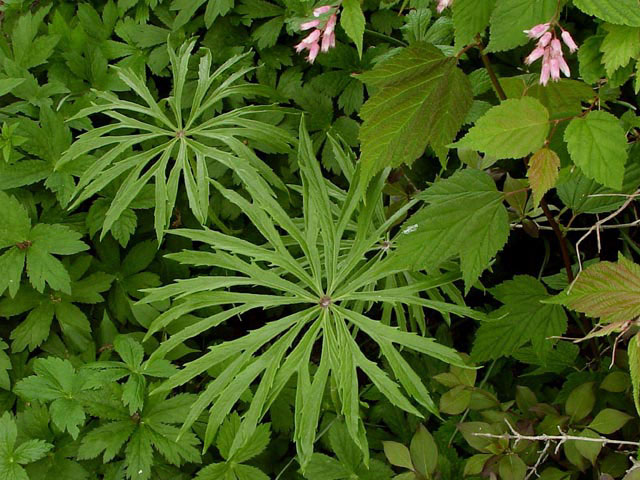
(P) to 2′. Shredded Umbrella Plant. Japan. Wonderful foliage plant very reminiscent of Aconitum, with woolly, peltate, deeply divided leaves. Clusters of small, fluffy pink flowerheads atop stiff, dark stems. Intriguing. Partial shade. 4 & T2

Category: Rarium | Sub-Category: Woodland
Scientific Name (Genus/Species): Syneilesis intermedia coll. DJHT 99104
Family: Asteraceae
(P) to 2′. Japan. Purchased from Heronswood Nursery in 2001. Wonderful foliage plant very reminiscent of Aconitum, with woolly, peltate, filigreed leaves. Clusters of small, fluffy pink flowerheads atop stiff, dark stems. Intriguing. Partial shade. 4 & T2


Category: Seminum | Sub-Category: Shrubs and Vines
Scientific Name (Genus/Species): Syringa reticulata
Family: (Oleaceae)
Hardy tree to 25′. Japanese Tree Lilac. A lovely, small tree with dark green leaves, downy beneath, and a well branched, rounded crown. Large, terminal panicles to 12 inches across of musk-scented, creamy white flowers. Fruits are warty, glabrous, persistent yet attractive. Older trees develop a warm chestnut brown, cherry-like peeling bark. Makes an excellent, trouble-free, specimen tree. June. Sun. PC- 4 weeks, 3 & T1

 Browse the index >>