Plant Index: Seminum / Rarium
Search/Filter Results:
Category: Seminum | Sub-Category: Alpine and Rock Garden
Scientific Name (Genus/Species): Antennaria plantaginifolia
Family: (Asteraceae)
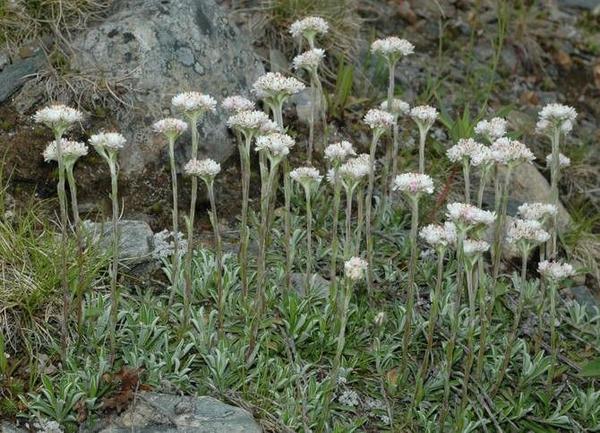
(P) to 10″. Ladies’ Tobacco. North American native. Mat forming, with ovate-elliptic, deeply veined, grey-green foliage that is sparsely woolly above, silver-grey and extremely woolly below. The flowers are in dense, terminal clusters, white to pale pink, resembling “Pussy-Toes.” Male and female parts are produced on different heads on different plants, with the female flowerhead often fluffier and the male flowers typically appearing on shorter flower stalks. This “Pussy-Toe” packs a punch. Blooms early spring. Sun. 3 & T2
Category: Seminum | Sub-Category: Alpine and Rock Garden
Scientific Name (Genus/Species): Anthyllis vulneraria var. coccinea
Family: (Fabaceae)
(P) to 6″. Kidney Vetch. Basal rosettes of deep green, paddle-shaped leaves with very light margins. Flowers are clustered, each containing a pale yellow tube with red lips. Flower stalks to eight inches tall and pale purple in colour. Blooms in May and June. Self-sows. Sun. 2B & 3 & 7 for 4 weeks, then T1


Category: Seminum | Sub-Category: Wildflowers
Scientific Name (Genus/Species): Apocynum cannabinum
Family: (Apocynaceae)
Native perennial to 4′. Dogbane, Indian Hemp. This sturdy grower features strong, reddish stems that branch towards the top and support cymes of small, five-petalled, scented, cream-coloured flowers at branch ends or on stalks from leaf axils. Silk, tufted seeds form in long, slender, string bean-shaped pods. Soft green, oval leaves have a distinct silvery midrib and are touched with a light, waxy bloom. Stem are fibrous, very strong, and were once used for sewing and to make rope. The plant is also used in phytoremediation as it is effective in sequestering lead from contaminated soils in its biomass. A good plant for meadows and wild places where it can colonize in accordance with its natural tendencies. Great golden autumn colour too. We grow ours at the Systematic Order Beds in a pot, to keep it in bounds. Sun and average soil. 3, 7 for 4 weeks, then T2

Category: Seminum | Sub-Category: Wildflowers
Scientific Name (Genus/Species): Aquilegia canadensis
Family: (Ranunculaceae)
(P) to 2′. Honeysuckle Columbine. A native of eastern North America. Nodding blossoms with red spurs surrounding yellow petals and yellow anthers and an extended stigma. Dark stems and delicate foliage. Late spring to early summer bloomer. Self-sows readily. Sun/partial shade. 4 & T2


Category: Seminum | Sub-Category: Alpine and Rock Garden
Scientific Name (Genus/Species): Aquilegia flabellata var. pumila
Family: (Ranunculaceae)
(P) to 12″. Japan. Short-spurred, pale lilac-blue flowers, often with paler or white markings. Rather compact growth and rounded, glaucous foliage. Sun. 4 & T2

Category: Rarium | Sub-Category: Alpine and Rock Garden
Scientific Name (Genus/Species): Aquilegia flabellata var. pumila f. rosea
Family: (Ranunculaceae)
(P) to 6″. Fan Columbine. A Japanese garden treasure with short-spurred, pale pink, nodding flowers in spring. Biternate to triternate, blue-green foliage is somewhat suggestive of meadow rue. The leaflets of this species are rounded and fan-shaped, hence the common name. Adorable. Sun. 4 & T2

Category: Seminum | Sub-Category: Perennials for Sun
Scientific Name (Genus/Species): Aquilegia vulgaris Mix
Family: (Ranunculaceae)
(P) to 3′. Columbine. Europe. The common name Columbine is derived from the Latin word for “dove” in reference to the resemblance of the inverted flower to five doves clustered together – a most descriptive image indeed. The intricate flowers can be nodding or horizontal and consist of five sepals and five petals to 1-½ inches long and come in a wide variety of colours, often developing dorsal hooked spurs. Interesting five, fused seed follicles follow. Each follicle has a long thin beak and holds many small, shiny, black seeds and persists until fall. The bushy, clump-forming plants have branched, thinly hairy stems and pinnate leaves, with the basal leaflets trifoliate. One of the most beloved plants appearing in an array of colours, sizes and forms, thanks to natural hybridization in the garden. In 2025 we collected seed from the colours below. Sun to part shade. 4 & T2
– Single Pink – Single Purple


Category: Seminum | Sub-Category: Alpine and Rock Garden
Scientific Name (Genus/Species): Arabis ferdinandi-coburgii
Family: (Brassicaceae)
(P) to 4″. Rockcress. Southeastern Europe. An easy growing, mat-forming perennial spreading up to 12 inches wide. Flowering white in clusters in early spring on five-inch stalks. A plant for sun or part shade in well-drained soil. 4 & T1

Category: Rarium | Sub-Category: Woodland
Scientific Name (Genus/Species): Aralia continentalis
Family: (Araliaceae)
(P) to 4′. Manchurian Spikenard. Clump-forming, architectural perennial with arching stems of alternate, bipinnate leaves. In midsummer, many terminal racemes of green flowers are soon followed by globose, blue-black fruit. Partial shade. Likes moisture. 3 & 7 for 4 months, then T1

Category: Seminum | Sub-Category: Woodland
Scientific Name (Genus/Species): Aralia cordata
Family: (Araliaceae)
(P) to 4.5′. Japanese Spikenard. Japan, Korea, China. Arching stems hold terminal panicles of pale greenish-white flowers in summer. Garnet-black berries cascade in autumn. Stunning. Happy in moist leafy soil in shade. 3 & 6A, then T2

Category: Seminum | Sub-Category: Alpine and Rock Garden
Scientific Name (Genus/Species): Arenaria sajanensis (syn. Minuartia obtusiloba)
Family: (Caryophyllaceae)
(P) foliage to 3″, flowers to 6″. Alaska to Oregon. Bright green, mossy mat of fine, needle-like foliage. Five-petalled, starry, white flowers with green veining cover the mat. Tough and attractive rock garden plant. Sun. 4 & T1

Category: Seminum | Sub-Category: Perennials for Sun
Scientific Name (Genus/Species): Aristolochia clematitis
Family: Aristolochiaceae
(P) to 30″. This non-climbing herbaceous Dutchman’s Pipe has small apetalous, tubular, greenish yellow flowers that bloom from late spring to early summer in clusters from the leaf axils. Each flower has a straight funnel-shaped tube with pointed, curved upper lips (considerably different in appearance from the curved Dutchman’s smoking pipe-type blooms found on some other species in the genus). Full sun to part shade. 4 & T3

Category: Rarium | Sub-Category: Woodland
Scientific Name (Genus/Species): Aruncus aethusifolius
Family: (Rosaceae)
(P) to 12″. A miniature Goat’s Beard from Korea. Bright green, finely dissected foliage forms a thick, lacy carpet. Small, dense, branched spikes of Astilbe-like, tiny, creamy flowers appear in summer. Foliage turns a beautiful burgundy in fall. Partial shade. 4 & T1

Category: Seminum | Sub-Category: Woodland
Scientific Name (Genus/Species): Aruncus dioicus
Family: (Rosaceae)
(P) to 5′. Goat’s Beard. Europe and Russia. The tall stature and presence of this Aruncus with its large, creamy white, feathery plumes makes it a show stopper for the back of the border. Prefers moist soil and partial shade. Early summer bloomer. 4 & T1

Category: Seminum | Sub-Category: Annuals for Sun
Scientific Name (Genus/Species): Asclepias curassavica
Family: (Apocynaceae)
(A/TP) to 4′. Blood Flower, Bastard Pecacuanha. A native of tropical America with cymes of 10+ small, cinnabar-red, five-petalled flowers with orange hoods. Upright foliage has pointed, elliptic, and opposite leaves. Blooms in late summer. Easy from seed but we dig ours up to overwinter. Sun. 3 & T2


 Browse the index >>